MARTIN
CRANE
RAFA THE SCORE
Rafa follows tennis icon Rafael Nadal through his last season, the ups and downs of matches and injury to his ultimate retirement. The film uses that present-tense reality as a springboard to dive into his past, weaving his origin story through the season as it unfolds. From the start, director Zachary Heinzerling made it clear he wanted music that could carry the weight of his themes of endurance, suffering, acceptance and rebirth.
The question for me as a composer is what does that sound like?

SLOWING DOWN TIME
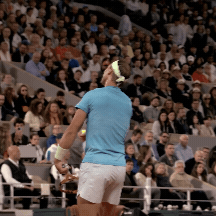
I started off by watching Rafa play on clay. He possesses the ability to make incredibly graceful slides that slow down time. As the clay dust wafts in the air, boom! A huge hit. That image of sliding and power influenced some of the early sounds we gravitated towards in development. Zach also uses slow motion footage throughout the series. Here are a few examples of the sounds that slow down time.
This is the main synth of Rafa. To me it feels like a classic clay slide. It's all over the score
This brass sound is a stack of sampled instruments. The tambre feels very clay to me, and I love the tails. I can hear Rafa's strength in these
Jawz is a nod to the past, but I love the tails. It focuses on the aftermath.
SLOWING DOWN TIME
I started off by watching Rafa play on clay. He possesses the ability to make incredibly graceful slides that slow down time. As the clay dust wafts in the air, boom! A huge hit. That image of sliding and power influenced some of the early sounds we gravitated towards in development. Zach also uses slow motion footage throughout the series. Here are a few examples of the sounds that slow down time.
This is the main synth of Rafa. To me it feels like a classic clay slide. It's all over the score
This brass sound is a stack of sampled instruments. The timbre feels very clay to me. I can hear Rafa's strength in these.
Jawz is a nod to the past, but I love the echo that follows the sound. It focuses on the aftermath.
Heart
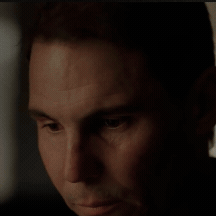
We had a large Frame.io account, and I was able to see the raw footage. Early in the project, I watched the unedited retirement announcement (ultimately used as the opener of the whole series) and was very moved by the scene. Rafa is unvarnished with a team of his coaches and friends helping him along, and you can feel how difficult it is for him. This scene, and the whole prospect of retirement, helped inspire a softer side of the music, one related to family and the generational passing of the torch. Textures such as these cascading pianos added pathos and vulnerability.
Heart
We had a large Frame.io account, and I was able to see the raw footage. Early in the project, I watched the unedited retirement announcement (ultimately used as the opener of the whole series) and was very moved by the scene. Rafa is unvarnished with a team of his coaches and friends helping him along, and you can feel how difficult it is for him. This scene, and the whole prospect of retirement, helped inspire a softer side of the music, one related to family and the generational passing of the torch. Textures such as these cascading pianos added pathos and vulnerability.
I provided as much music as possible before the start of the edit. Using references Zach shared, we explored many ideas of what music could be. Though few of these drafts made it in the score, they all informed our palette. Documentary editing follows strange, circuitous routes as each modular scene is built from scraps of footage (Rafa shot over 500 hours). Having a library of music can help facilitate that.
I'm blessed to have great collaborators who are gifted with placing music. Editor Drew Blatman in particular would sometimes take apart and recombine pieces of music. His choices always served the story.
EDITING AS WRITING
a random scrub through the scraps of ideas... still unformed
Breakthrough
where it started
Midway through our edit, we still had not found the capital T theme. We were looking for a piece of music that balanced strength and fragility in a way that could be used both during Rafa's victories on the court and Rafa's ultimate victory over retirement.
At some point in the process, Zach suggested I revisit a song I'd made for a project of his over a decade ago. It was a lilting, off-the-grid flute phrase, impossible to recreate, the kind of noodle you'd normally throw away. But it had the kernel of our theme.
I wrote out several versions of it... slow piano, big drums, stretching out.
iterating...

I get a text message from Zach very late in the evening about one of the most crucial scenes, the so called "Greatest Match" where Rafa wins Wimbledon 2008. Can I try out a piano version? He picked out 20 second of improvisation on it and said run with it... This ended up being my favorite scene in the whole series, and it is also a window into how good directors get their film.
After scoring the Wimbledon scene, I pretty quickly stumbled on to the final theme, called "French History". You can hear the first track that Zach liked within this, as well as some of the earlier signature sounds. I knew we'd arrived at our sound.
where it ended
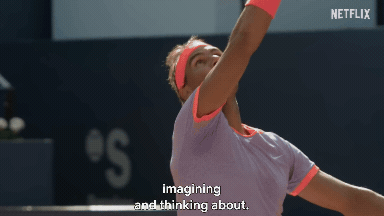

having discovered a template of sorts and a melodic heart for the central set piece, I wrote most of the other orchestral pieces over the course of an excited and inspired weekend. I was not at my studio, so I wrote them on my laptop. 2 days of those creative bursts is worth 2 months of toiling.
EDITING AS WRITING
I provided as much music as possible before the start of the edit. Using references Zach shared, we explored many ideas of what music could be. Though few of these drafts made it in the score, they all informed our palette. Documentary editing follows strange, circuitous routes as each modular scene is built from scraps of footage (Rafa shot over 500 hours). Having a library of music can help facilitate that.
I'm blessed to have great collaborators who are gifted with placing music. Editor Drew Blatman in particular would sometimes take apart and recombine pieces of music. His choices always served the story.
a random scrub through the scraps of ideas... still unformed
Breakthrough
where it started
iterating...
Midway through our edit, we still had not found the capital T theme. We were looking for a piece of music that balanced strength and fragility in a way that could be used both during Rafa's victories on the court and Rafa's ultimate victory over retirement.
At some point in the process, Zach suggested I revisit a song I'd made for a project of his over a decade ago. It was a lilting, off-the-grid flute phrase, impossible to recreate, the kind of noodle you'd normally throw away. But it had the kernel of our theme.
I wrote out several versions of it... slow piano, big drums, stretching out.
I get a text message from Zach very late in the evening about one of the most crucial scenes, the so called "Greatest Match" where Rafa wins Wimbledon 2008. Can I try out a piano version? He picked out 20 second of improvisation on it and said run with it... This ended up being my favorite scene in the whole series, and it is also a window into how good directors get their film.
where it ended
After scoring the Wimbledon scene, I pretty quickly stumbled on to the final theme, called "French History". You can hear the first track that Zach liked within this, as well as some of the earlier signature sounds. I knew we'd arrived at our sound.
having discovered a template of sorts and a melodic heart for the central set piece, I wrote most of the other orchestral pieces over the course of an excited and inspired weekend. I was not at my studio, so I wrote them on my laptop. 2 days of those creative bursts is worth 2 months of toiling.
How does one piece of music end up in a specific scene?
The editors of Rafa would often start to work scenes around pieces of music specifically so the rhythm and vibe of the music gets built in from the star. For other scenes, I either write to it or pick something I've written. Towards the end of a project, we develop a musical vocabulary.
Edits go through many iterations... 4 or 5 major milestones to be reviewed by NETFLIX, but 50 or 60 internal passes per episode. Each pass requires small changes, some of which we keep.
How does one piece of music end up in a specific scene?
The editors of Rafa often started scenes around pieces of music specifically, so the rhythm and vibe of the music gets built in from the start. For other scenes, I write to it or adapt something I've written. Towards the end of a project, we develop a musical vocabulary.
Edits go through many iterations... 4 or 5 major milestones to be reviewed by NETFLIX, but 50 or 60 internal passes per episode. Each pass requires small changes, some of which we keep.
Homestretch

Finishing
I asked Rob Moose, the very talented violinist and arranger, to record strings for some of the major moments. His sense of phrasing and tone are spectacular, and they breathed life into the music in a way I did not realize was possible. He has a room of 20 violins and plays each part slightly differently to mimic the sound of an ensemble. His playing is all throughout Rafa. Here are his solo strings from our theme. Just beautiful.

With all the music more or less placed and the cuts extremely close to final, I make a finishing pass. Tiny differences, like the length of a fade or the specific beat of an entrance, can make dramatic changes to the flow. I mix my own music.
I asked Rob Moose, the very talented violinist and arranger, to record strings for some of the major moments. His sense of phrasing and tone are spectacular, and they breathed life into the music in a way I did not realize was possible. He has a room of 20 violins and plays each part slightly differently to mimic the sound of an ensemble. His playing is all throughout Rafa. Here are his solo strings from our theme. Just beautiful.
With all the music more or less placed and the cuts extremely close to final, I make a finishing pass. Tiny differences, like the length of a fade or the specific beat of an entrance, can make dramatic changes to the flow. I mix my own music.

MARTIN
CRANE

Martin Crane is a Brooklyn-based composer for film and television. His score for RAFA, Zachary Heinzerling's four-part documentary series about Rafael Nadal, premiered on Netflix in May 2026; the series earned a Primetime Emmy nomination, and The Hollywood Reporter named the score in its Emmy forecast. Recent credits include The Antisocial Network (Netflix), Stolen Youth (Hulu), Loved One (feature, prod. Paul Mezey), and PBS Frontline. Before scoring, Crane released records as Brazos on Dead Oceans. He works from his Dumbo studio.